

Keyword Cannibalization Fixes That Don’t Tank Traffic: A Consolidation Playbook Using GSC + Canonicals + Internal Links
admin | | 9 min read
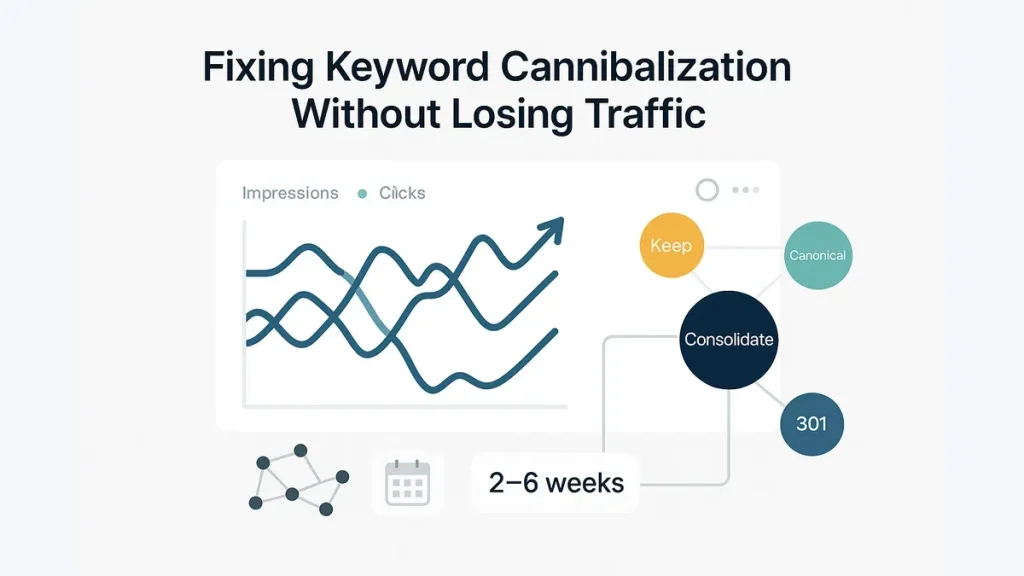
Fix cannibalization without a traffic cliff by treating it like controlled consolidation: prove overlap in Google Search Console (GSC), pick one primary URL, move unique long-tail coverage into it, then back it with consistent canonicals/redirects and internal links—and confirm the winner in GSC.
What a “safe” keyword cannibalization fix looks like
Keyword cannibalization is when multiple URLs compete for the same query and intent, pushing Google to choose between them (often by testing different URLs over time). That’s different from a healthy topic cluster, where pages target distinct intents and support each other through internal links and clear roles (hub → spokes, guide → comparison, category → product).
“Don’t tank traffic” means preserving clicks and conversions while consolidating ranking signals. Some volatility is normal as Google reprocesses changes; the goal is to avoid a sustained click drop—especially on long-tail queries the “secondary” URL may be quietly winning.
Don’t consolidate when pages need to stay separate:
- Distinct intent: “best CRM for freelancers” (comparison) vs “how to set up a CRM as a freelancer” (tutorial).
- Different funnel stage: “CRM software” (solution/category) vs “CRM definition” (informational guide).
- Different format requirement: tool vs blog post; category page vs guide.
- Local vs national: a city landing page shouldn’t be merged into a national service page.
Brand SERPs and sitelinks can make “multiple URLs show up” look like cannibalization. If queries are branded/navigational, consolidation risk rises; verify identical intent before touching URLs.
Promise for this playbook: pick a winner, preserve unique long-tail coverage, concentrate signals, and confirm the outcome in GSC.
Example: a “CRM for freelancers” guide plus a “CRM pricing calculator” tool can overlap without being a problem. Two near-identical “best CRM for freelancers” list posts usually is.
Diagnose cannibalization in Google Search Console (and capture a baseline)
Use query-level evidence in GSC and take a baseline so you know what must be preserved.
Exact GSC path (per priority query):
- Performance → Search results.
- Set a date range (last 28 days for recent behavior, last 3 months for stability).
- Add a Query filter (regex is fine for close variants).
- Open the Pages tab to see which URLs got impressions/clicks for that query.
Patterns that indicate cannibalization:
- URL swapping over time (A one week, B the next).
- Split impressions/clicks across 2+ URLs for the same query.
- CTR dilution: impressions spread across URLs with no consistent winner.
- Mixed roles: one URL holds position while another steals clicks (often better snippet/title).
Baseline checklist:
- Current winning URL (most clicks, best average position, or most stable).
- Secondary/competing URL(s).
- Top queries to preserve (including queries where the secondary shows up).
- Snapshot of clicks/impressions/avg position for the target query and each competing page.
- Optional: conversions by landing page (GA/analytics).
A simple “before” log is enough:
- Query:
best crm for freelancers - Competing URLs:
/blog/best-crm-freelancersand/blog/crm-for-freelancers - Last 28 days: URL A = 220 clicks, URL B = 70 clicks; swapping in week 2
- Chosen primary (tentative): URL A
- Secondary long-tail to preserve:
best free crm for freelancers,crm pricing for freelancers
Micro example (GSC-driven proof): Query = “best crm for freelancers” shows Page A and Page B alternating clicks week to week. Pick Page A as primary, migrate Page B’s unique “pricing” coverage, then consolidate signals.
Choose the consolidation method: keep separate vs canonical vs 301 redirect
Traffic cliffs usually come from choosing the wrong method, or leaving conflicting signals after the change.
Keep separate (de-overlap)
Keep both pages when intent/funnel/format genuinely differs. Reduce overlap so Google has fewer reasons to “test” both.
- Retarget each page’s primary query (titles/H1s and above-the-fold framing).
- Remove or compress overlapping sections that make the pages look interchangeable.
- Make internal links decisive: hubs and nav should point to the page that owns the intent.
Failure mode: the pages still share the same title pattern, H1, and anchors, so swapping continues.
rel=canonical
Use rel=canonical for near-duplicates that must remain accessible (parameters, print versions, tracking variants). Canonicalization consolidates indexing signals, but it’s a hint, not a guarantee.
- Canonical variants to one clean URL.
- Point internal links to the canonical URL.
- Keep sitemaps aligned to the canonical.
Failure mode: canonicals between different-intent pages, or canonicals that conflict with internal links/sitemaps.
301 redirect
Use a 301 when you’re doing a true merge and the secondary page should stop ranking.
- Move unique content first.
- Then 301 secondary → primary (single hop).
- Update internal links and XML sitemaps to the primary.
Expectation setting: recrawl and signal reattribution takes days to weeks, not minutes.
What not to do (common causes of loss):
- Canonical between genuinely different-intent pages.
- Redirect a page that still serves a distinct use case.
- Redirect chains.
- Mixed signals (canonical to A, but internal links/sitemaps push B).
Edge cases to normalize first: parameters (?utm=, filters, sort), trailing slash vs non-slash, HTTP/HTTPS, www/non-www, duplicate paths/case variants. Pick one clean primary URL and make everything else resolve to it via canonicalization/redirects.
Reference: https://developers.google.com/search/docs/crawling-indexing/consolidate-duplicate-urls
CTA: Use Seosoft’s Canonical Checker to confirm your intended canonical matches what’s implemented (and spot mismatches early): /canonical-checker
Micro example (canonical): /product?color=red and /product?color=blue must remain accessible. Add canonical to /product and point internal links to the canonical version.
The consolidation playbook (step-by-step)
Follow this sequence to protect long-tail queries and avoid “I redirected it and lost half my clicks.”
Step 1: Pick the primary URL
Choose the winner using durability signals:
- Strongest backlinks (quality + relevance)
- Best historical rankings / stable impressions
- Highest conversions (if measured)
- Best match to the intent you’re consolidating
- Fresh, complete content
- Clean URL structure
If the “weaker” page converts better, treat that as a carry-over requirement (framing, sections, proof).
Step 2: Merge content without losing long-tail
Before any redirect/canonical, inventory what the secondary URL uniquely contributes (especially what shows up in GSC):
- Unique headings
- FAQs aligned to long-tail queries
- Examples/comparisons/definitions
- Tables or checklists that win snippets
Migrate only what earns its place. Skip copy-paste bloat; the primary should get clearer, not just longer.
Example: if Page B ranks for “best free crm for freelancers,” add a focused “Free plans to consider” section to Page A under a clear H2/H3.
Step 3: Update on-page signals on the primary page
Make it obvious the primary URL is the definitive result for that intent:
- Title/H1 aligned to the primary query (comparison vs how-to vs definition).
- Headings that cover retained sub-intents (pricing, setup, integrations).
- Internal anchors/jump links updated to consolidated sections.
- Breadcrumbs/category context corrected where relevant.
CTA: Draft clean titles/meta descriptions for the consolidated page with /meta-tags-generator.
Step 4: Implement the chosen consolidation method
Execute one approach cleanly:
- If 301 redirect: confirm migrated content exists, then 301 secondary → primary (single hop). Keep the primary’s canonical self-referencing.
- If rel=canonical: set canonicals on duplicates to the primary and align internal links to the canonical. Keep the primary canonical self-referencing unless there’s a deliberate reason not to.
Update XML sitemaps so they list the canonical/primary URL, not deprecated variants.
Step 5: Cleanup
Remove leftovers that keep Google testing multiple URLs:
- Update tables of contents/jump links that reference old URLs
- Fix breadcrumbs/navigation links to deprecated URLs
- Verify response codes: primary returns 200; redirected pages return 301 (not 302)
- Avoid mixed directives (redirecting but canonicalizing elsewhere)
CTA (optional, single-step): If the consolidated page supports it (FAQ/software list/product), add relevant markup with /schema-generator.
Internal linking fixes that lock in the winner
Even with a correct 301/canonical, internal links can keep splitting relevance and PageRank—especially from templates, hubs, and older posts.
How to find internal links to non-primary URLs:
- Site search:
site:yourdomain.com "old-slug" - CMS link search (if available)
- A crawler export of inlinks
- GSC Links report as a clue (not exhaustive)
Update strategy (highest leverage first):
- Replace links to secondary URLs with the primary.
- Fix navigation, hub pages, and templates first (they replicate across the site).
- Update breadcrumbs so they point to the intended destination.
Anchor text consolidation:
- Use the primary query (and a few natural variants) as the dominant anchor pattern.
- Point sub-intent anchors (e.g., “CRM pricing for freelancers”) to the primary page section, not a competing URL.
- Avoid splitting similar anchors across multiple pages “just in case.”
Prevent re-cannibalization: for an established intent, link to the primary page. Create a new page only when intent, funnel stage, or format differs.
Micro example: after choosing Page A as primary, update internal links from 12 blog posts that still point to Page B so they now point to Page A.
Validate and monitor in GSC (with rollback triggers)
Consolidation isn’t done when you publish. Validate immediately, then monitor long enough to see signals consolidate.
Immediate checks (same day)
- URL Inspection (primary): confirm it’s indexable and user-declared canonical and Google-selected canonical match your intent.
- URL Inspection (deprecated):
- if 301: confirm a single-hop redirect to the primary
- if canonical: confirm it’s accessible and canonical points to the primary
- Indexing expectations: days to weeks for recrawl and signal reattribution.
If Google-selected canonical doesn’t match:
- Remove conflicting signals (internal links, sitemap entries, inconsistent canonicals)
- Request indexing again
- Recheck after recrawl
Monitor for 2–6 weeks in GSC
Use the same query set you baselined:
- Performance → Search results → filter to the query (or regex group)
- In Pages, impressions/clicks should consolidate onto the primary.
- Watch for reduced URL swapping, CTR stability, and clicks moving from secondary to primary.
Benign vs concerning signals:
- Benign: short-term position/CTR wobble while Google tests; impressions shift to the primary.
- Concerning: sustained click drop, or the wrong page becoming the canonical/ranking result.
Rollback triggers (and what to do)
Define a threshold before you react, and sanity-check it against context (GSC can be noisy; annotate changes; account for seasonality, promos, and tracking gaps). Example trigger:
- If the consolidated query set shows a >20% click drop for 14 consecutive days versus baseline after adjusting for obvious seasonality or sitewide changes, investigate.
Corrective actions:
- Wrong canonical after repeated recrawls: remove conflicts (internal links/sitemap/canonical tags), then re-request indexing.
- Primary mismatch to intent: rewrite title/H1, fix above-the-fold framing, align to what the query expects.
- Long-tail loss: restore missing sections you removed during the merge.
- Redirected but now need separation: revert the 301 (if feasible), restore the secondary page, split content by intent.
Optional (large sites): if crawl is a constraint during a batch rollout, you can manage crawl focus temporarily via robots.txt—but it’s not the fix for cannibalization. If you need it, generate a draft here: /robots-txt-generator
Conclusion: the traffic-safe next actions
Run this in order and you’ll usually stop URL swapping without sacrificing the secondary page’s long-tail.
- Prove overlap in GSC (Pages-by-query) and capture a small baseline log.
- Pick the primary URL based on intent fit plus durability (links, history, conversions).
- Choose the lightest effective consolidation method: keep separate if intent differs, canonical for required duplicates, 301 for true merges.
- Merge what the secondary uniquely earned (headings, FAQs, examples) and tighten the primary’s title/H1 and section structure.
- Make internal links agree (nav, hubs, templates, and high-traffic posts).
- Validate canonicals/redirects immediately, then monitor the same query set for 2–6 weeks.
Expect some short-term wobble. Intervene when clicks drop beyond your threshold or Google keeps selecting the wrong canonical—both are fixable, but only if you catch them early and remove signal conflicts.
Further reading: Google Search documentation.